
Production6 min read
Plastic Cup Production Efficiency: Lower Cost, Zero Waste
Learn how to achieve optimal plastic cup production efficiency. Practical ways to reduce waste and save production cost from the earliest stages.
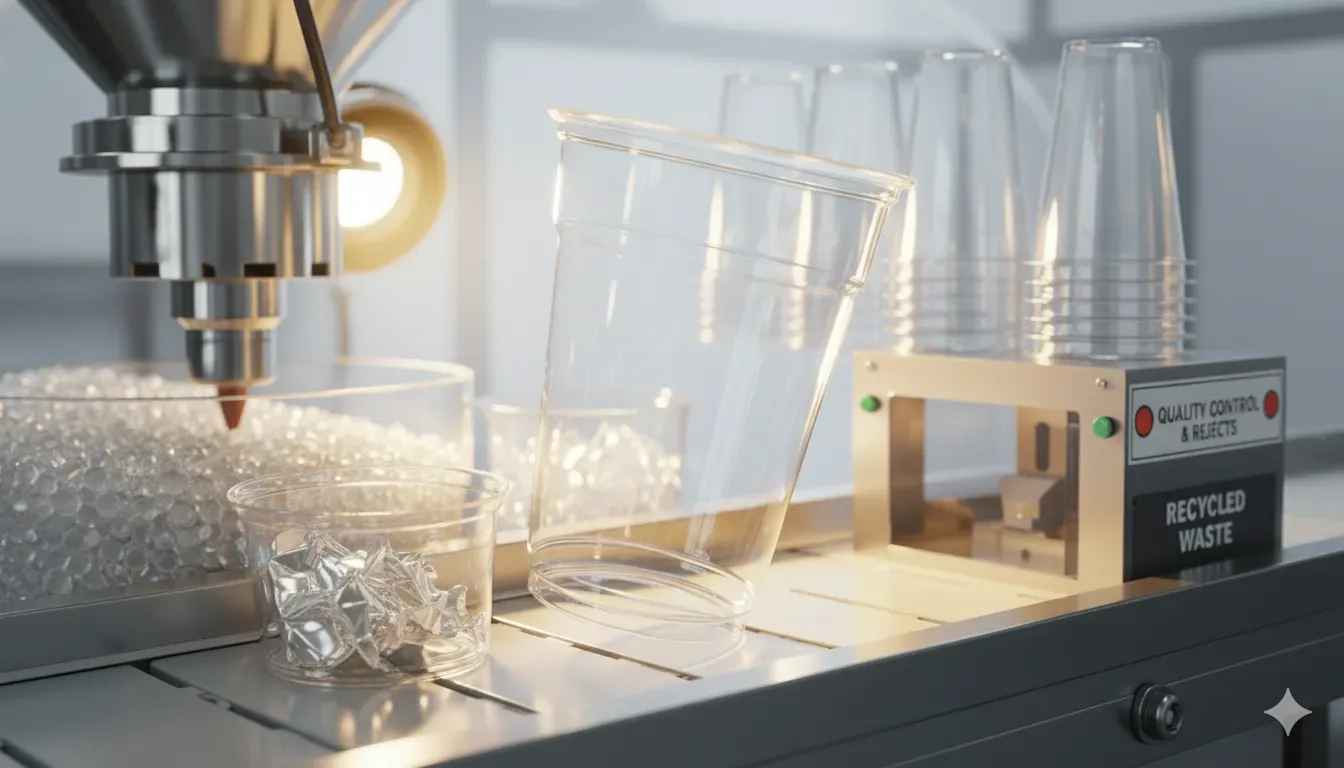
Plastic Cup Production Efficiency: Tips to Reduce Waste and Save Cost from the Start
The Key to Modern Plastic Cup Production Efficiency: Data and Parameters That Matter
Plastic cup factory efficiency is not measured by machine speed alone, but by how optimally all production parameters work together. The three numbers most often used to measure injection molding line performance are OEE (Overall Equipment Effectiveness), scrap rate, and output per machine per hour.
Typical injection molding OEE for the thinwall cup segment is:
- 65% OEE — baseline for conventional factories with hydraulic machines and operators that are not yet optimally trained
- 75% OEE — benchmark for factories with standardized SOPs, routine preventive maintenance, and molds in good condition
- 85% OEE — world-class target achieved by factories with full automation and servo-electric drives
An acceptable scrap rate for food-grade production is around 1.5–2.5% per batch. Above 3%, the operation needs a process audit — usually caused by unstable barrel temperature, molds needing maintenance, or raw material moisture above tolerance.
One injection molding machine with a 16-cavity mold and 7-second cycle time produces around 8,200 cups per hour under normal operating conditions. At 75% OEE, effective output becomes around 6,150 cups per hour per machine. This number is the starting point for calculating capacity requirements and negotiating pricing with manufacturers.
In short, plastic packaging production optimization is not just about having advanced machines; it is about ensuring every parameter — from resin quality to coolant temperature — works within the defined tolerance.
What Causes Inefficiency in Plastic Cup Production?
To achieve optimal plastic cup production efficiency, first identify the root causes. These are the five main determining factors:
- Machine Quality and Condition: Old, frequently broken, or poorly maintained machines directly reduce OEE. Older hydraulic machines consume 30–50% more energy than new servo-electric machines for the same output.
- Raw Material Management: PP resin with moisture above 0.05% creates splay marks and bubbles — immediately increasing scrap rate. Inconsistent resin quality between batches also forces machine-parameter adjustments that waste setup time.
- Production Flow and Work Process: Bottlenecks at QC stations or packing areas often stop machine lines that are otherwise running efficiently. Value-added analysis at each workstation is needed to identify non-production waste.
- Human Resource Quality: Operators not trained to read machine parameters or recognize early signs of production defects allow high scrap rates to continue too long. Regular training reduces average defect rates by 20–30%.
- Poor Waste Management: Runners and sprues from each injection cycle create regrind. Without strict segregation, contaminated regrind can re-enter production and lower output quality — or be discarded entirely as cost waste.
7 Effective Strategies to Maximize Plastic Cup Production Efficiency
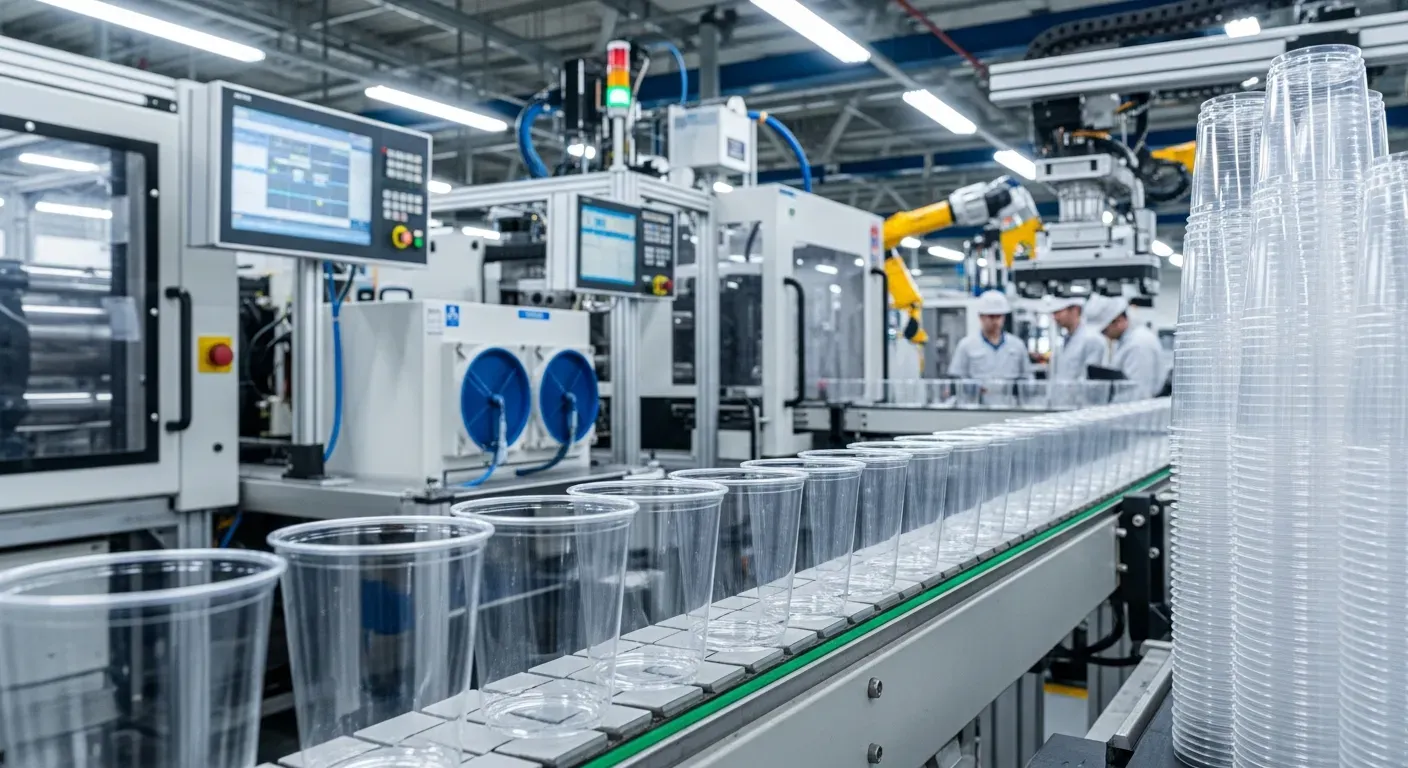
Once the barriers are identified, these seven strategies can measurably improve plastic packaging manufacturing efficiency.
- Standardize Production Processes: Set SOPs with clear parameter tolerances — barrel temperature ±5°C, injection pressure ±50 bar, cycle time target per SKU. This reduces shift-to-shift variation and makes troubleshooting easier when OEE drops.
- Manage Raw Materials Properly: PP resin dryers must operate consistently at 80°C for 2–4 hours before production begins. Use FIFO for resin stock rotation — resin stored longer than 6 months needs longer re-drying.
- Run Routine Preventive Maintenance: Schedule weekly PM (nozzle cleaning, hydraulic or servo seal checks) and monthly PM (mold checks, temperature sensor calibration). Every hour of unplanned downtime equals roughly 8,200 cups not produced.
- Train and Develop Employees: Operators who can read shot weight and detect early burn marks can prevent a defective batch before it grows. Training based on actual QC data is more effective than generic procedural training.
- Optimize Factory Layout: Position incoming resin, machine lines, QC stations, and packing areas in a one-way flow to minimize material movement. Shorter material travel directly reduces total cycle time.
- Use Recycling and Waste Management Systems: Runner and sprue regrind from non-food-contact lines can be reused. Strict segregation between food-grade and non-food regrind is required under FSSC 22000. This system reduces raw material cost by 3–8% depending on volume.
- Apply Automation Technology: Pick-and-place robots at the machine exit remove manual-handling bottlenecks and increase production speed by 20–40% compared with manual lines. Automated vision inspection detects visual defects more consistently than manual inspection.
How Automation and Innovation Accelerate Plastic Cup Production
Automation technology has a measurable impact on plastic cup packaging manufacturing capacity and consistency. Non-stop pick-and-place robots eliminate manual handling variability and allow machines to run at optimal cycle time without interruption.
Modern plastic injection machines with servo-electric drives consume 30–50% less energy than conventional hydraulic machines for the same output. At 10 million cups per month, these energy savings create significant annual operating cost reductions — and become the main ROI argument for machine upgrades.
New-generation sensor and precision-control technology enables:
- Real-time shot weight monitoring per cycle — detecting deviations before they become defective batches
- Barrel temperature control within ±1°C versus ±5–10°C on older machines
- Automatic batch data logging for FSSC 22000 traceability
IoT systems integrated with monitoring dashboards allow supervisors to see OEE across all lines in real time, not only after the shift ends. This shifts production management from reactive to predictive — problems are identified when they happen, not after they affect the product.
Anti-Waste: How to Reduce Waste and Improve Plastic Cup Quality
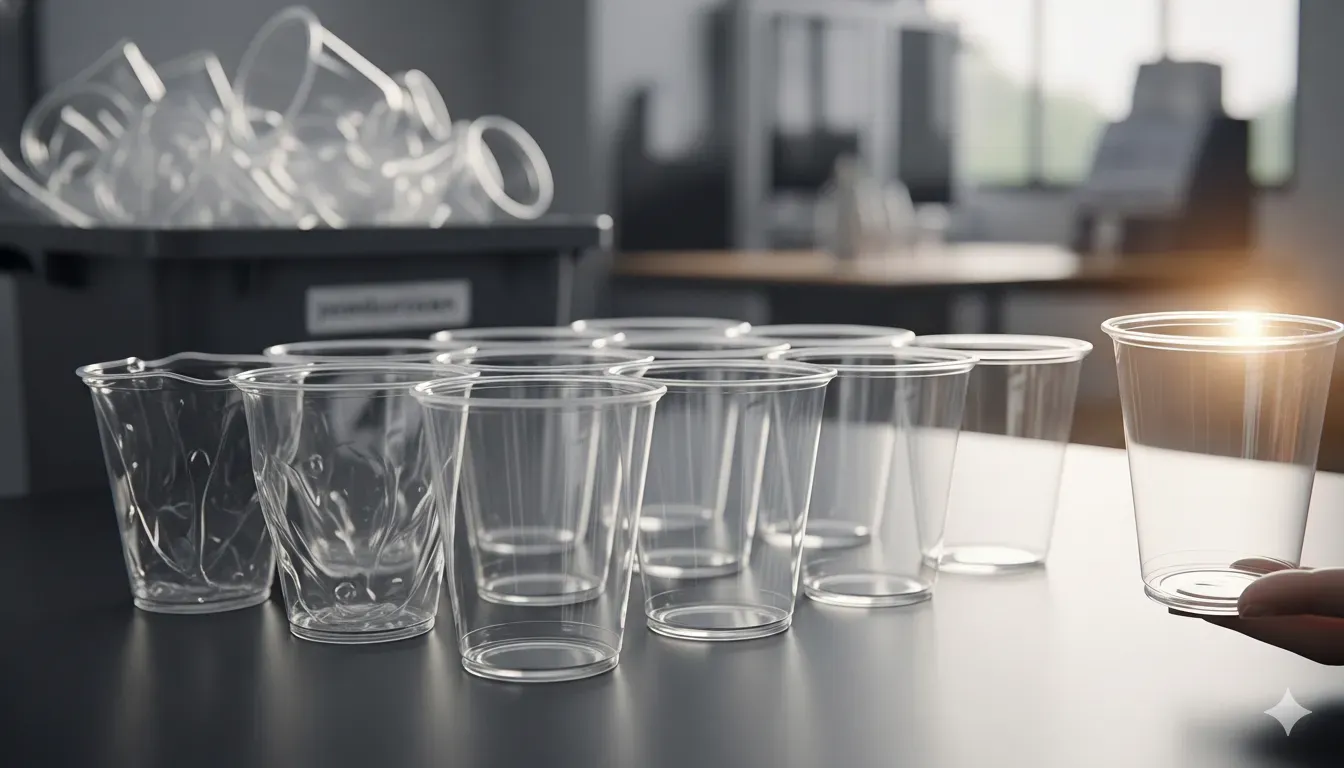
Anti-waste strategy in plastic cup packaging production starts with process design, not waste handling at the end of the line.
Focus on defect prevention at the source. Proper barrel temperature and injection pressure settings directly reduce scrap rate below 1.5%. Every 1% reduction in scrap rate at 10 million cups per month equals 100,000 cups saved from recycling or disposal.
Use data-based quality control, not only visual inspection. Cup weight sampling per cycle (shot-weight monitoring) provides early detection of dimensional deviation before it affects the entire batch.
Use regrind systematically. Runners and sprues from each injection cycle create regrind that can be reused for non-food-contact production. Strict segregation between food-grade and non-food-grade regrind is required under FSSC 22000 — do not mix the two.
Invest in QC operator training. Teams that understand the root cause of each defect type — short shot from low barrel temperature, burn mark from excessive temperature, flash from insufficient clamping force — can correct parameters faster and more accurately.
Case Study and Future Outlook: Achieving Maximum Profit with Optimal Efficiency
With a combination of SOP standardization, preventive maintenance, and partial automation, an injection molding factory moving from 65% OEE to 75% OEE achieves around 15% effective output increase without adding machines. At 8 million cups per month, a 10-point OEE difference equals 1.2 million additional cups per month from the same capacity.
Upgrading to servo-electric machines with 40% energy savings provides ROI in 18–36 months depending on electricity rates and production volume. For factories operating two shifts, break-even is generally achieved in under 24 months.
Looking ahead, AI integration for predictive maintenance — analyzing vibration and power-consumption patterns to predict failures before they happen — will become an industry standard. Machines that "learn" from historical operating data can automatically adjust parameters to maintain optimal OEE without operator intervention.
Factories that invest in plastic packaging production optimization today — through data, automation, and trained people — are better positioned to fulfill large-volume contracts with auditable quality consistency. For buyers, this is the main reason FSSC 22000 certification and OEE data transparency should be important criteria in vendor selection. For more information on government efforts in plastic waste management and the circular economy, refer to official sources such as Indonesia's Ministry of Environment and Forestry.
See more about plastic cup quality testing standards applied after production, including AQL protocols and physical durability tests. Or visit Wingoh injection plastic cup products for production capacity and available customization options.