
Production8 min read
How Plastic Cups Are Made: The Complete Process
Learn how plastic cups are made from raw material to ready-to-use product. Follow each production stage in this detailed buyer-oriented guide.
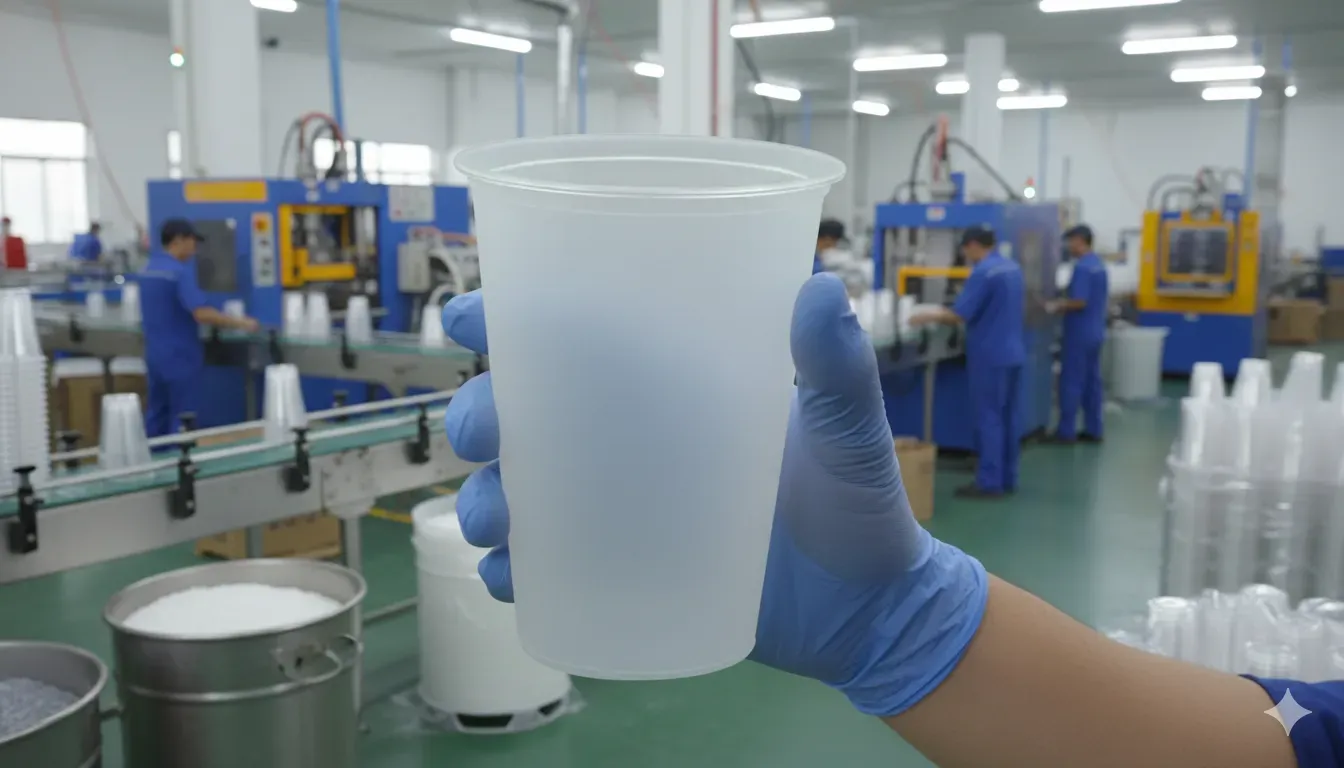
Plastic Cup Production Process: From Raw Material to Ready-to-Use Product
Why Do Plastic Cups Dominate F&B Packaging Needs?
Plastic cups are not just a commodity product — they are a critical component in the daily operations of thousands of F&B businesses in Indonesia. Understanding the plastic cup production process from upstream to downstream gives buyers, procurement managers, and F&B operators the right perspective when evaluating manufacturing partners.
The main advantages of plastic cups in commercial applications are not only about price. Plastic cups offer several technical advantages that are difficult to replace: light weight that lowers logistics cost, dimensional consistency compatible with automatic sealing machines, the hygiene of new packaging that meets food-safety requirements, and enough physical strength for delivery distribution.
With Indonesia's output reaching hundreds of millions of units per month for the F&B segment alone, understanding how these cups are made — with which parameters and under which standards — is the foundation of good vendor qualification.
This segment is dominated by two material groups: food-grade PP for hot and cold applications, and PET for clear cold-drink cups. Other plastic cup materials such as PLA are also available for eco-premium segments. Material choice determines the technical specifications of the entire production process.
When a buyer requires dimensional consistency for machine sealing, or when a distributor needs cups that can withstand logistics shocks, it all comes back to technical decisions made during mold design and injection molding parameter setup.
7 Steps in Plastic Cup Production with Injection Molding
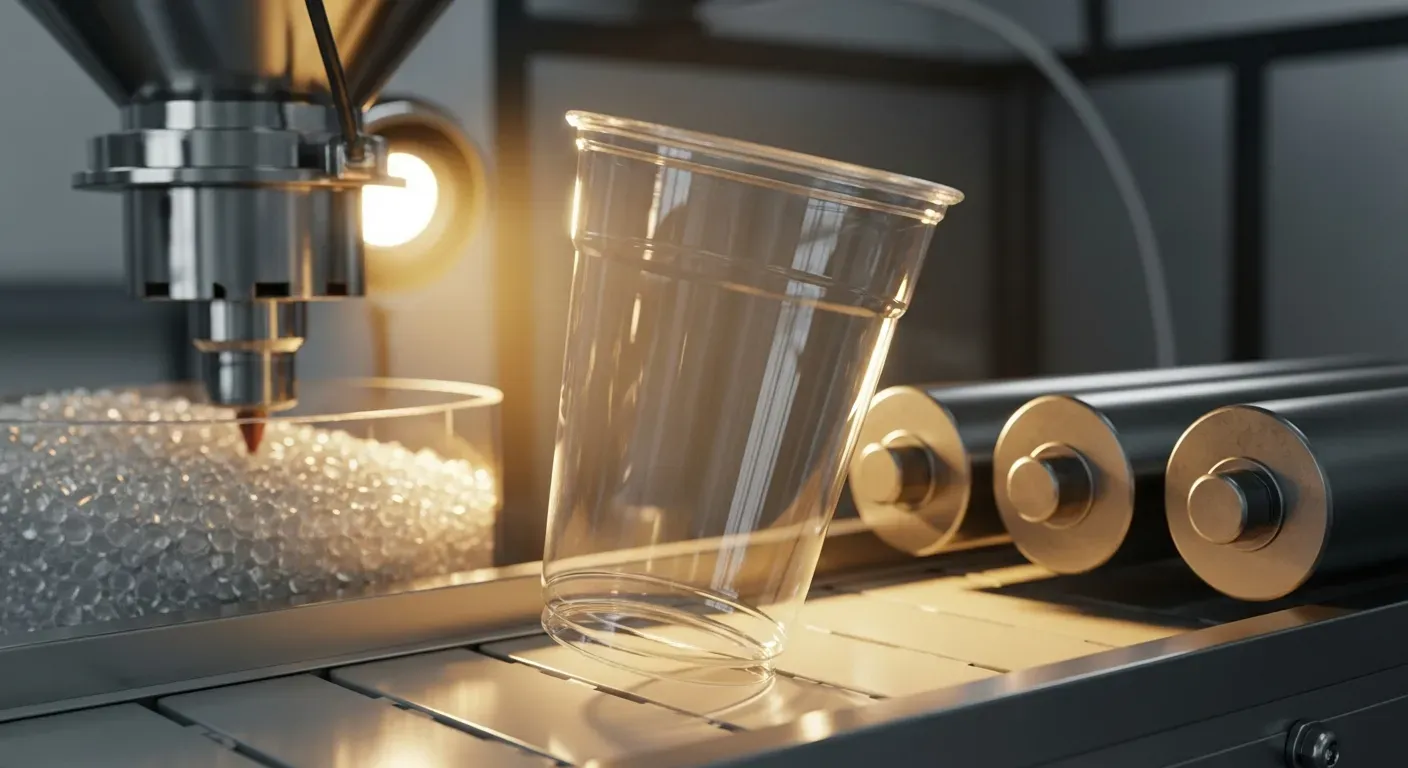
Wingoh produces plastic cups using injection molding — a high-pressure molding process that delivers precise dimensions and uniform walls. Unlike thermoforming, which shapes plastic sheet, injection molding injects molten PP resin directly into a closed mold. Below are the seven stages of the injection-molded plastic cup production process from raw material to ready-to-ship product.
-
PP Resin Drying Food-grade Polypropylene (PP) resin pellets, resin code #5, with density of 0.905 g/cm³ and Melt Flow Index (MFI) 30, are dried in a hopper dryer at 80°C for 2–4 hours. The target moisture level must be below 0.05% before the pellets enter the barrel. Moist resin creates splay marks and hidden voids in the cup wall. This step is invisible in the finished product, but it determines dimensional consistency across the batch.
-
Heating and Plasticization in the Barrel Dried resin enters the injection machine screw barrel. Barrel temperature zones rise gradually: zone 1 at 180°C, zone 2 at 200°C, zone 3 at 220°C, and zone 4/nozzle at 235°C. The rotating screw shears and homogenizes the resin until it becomes molten plastic ready for injection. Temperature control in every zone is critical: too low causes short shots, while too high degrades the resin and leaves brownish burn marks.
-
Injection into the Mold Molten PP is injected into the closed mold through hot-runner channels at 800–1,200 bar. A standard mold for a 16 oz thinwall cup uses a 16-cavity configuration — each cycle produces 16 cups at once. All 16 cavities fill in 0.4–0.8 seconds. Machine clamping force is set between 150–300 tons to prevent flash, the plastic leakage at the mold parting line that creates jagged cup edges.
-
Holding Pressure / Packing After the cavities are full, the machine maintains injection pressure for several seconds to compensate for resin shrinkage. This holding stage prevents sink marks and ensures the actual cup weight matches specification. Holding pressure and duration are calibrated per SKU according to geometry and target wall thickness.
-
Cooling Cooling is the longest stage in the cycle — usually 60–70% of total cycle time. Cooling channels inside the mold carry water at 15–25°C, absorbing heat from the resin and freezing the cup shape. PP shrinks 1.5–2.0% as it cools; mold dimensions are designed 1.7% larger than the final target to compensate. Total cycle time for a 16 oz thinwall cup on a 16-cavity mold is around 6–9 seconds per cycle, equal to more than 6,400 cups per hour per machine.
-
Ejection The mold opens and ejector pins push the solidified cups out of the cavities. A robot or conveyor carries the cups out of the press area. Sprues and runners — hardened resin channels — are separated, ground into regrind, and routed to non-food-contact production under FSSC 22000 procedures. Regrind is not blended back into food-grade production lines.
-
Quality Check + Stacking Every batch passes visual inspection and dimensional sampling. QC samples 10% of output for weight, dimensions (height, top/bottom diameter, wall thickness), drop testing, and defect detection: short shot, burn mark, flash, bubble, and sink mark. Cups that pass QC move to logo printing if required, then are packed in 5-ply cartons. A standard 16 oz cup carton contains 1,000 pcs/carton, sealed before warehousing.
These seven stages run continuously in one injection molding line. Every parameter — from barrel temperature to clamping pressure and cooling rate — is recorded per batch as part of an FSSC 22000-certified quality traceability system. The result is a food-grade PP plastic cup with consistent dimensions that can be verified through factory audit.
How Should Buyers Choose Raw Material and Cup Production Machines?
Two early decisions determine the entire production output: plastic cup material and machine specification. For buyers assessing a partner factory's capability, these are the first evaluation points.
Choosing plastic cup material is not simply about cheap versus expensive. Consider the cup function, food-safety standards, and recyclability for the end customer:
- Polypropylene (PP): The dominant material for food-grade injection-molded cups. Heat-resistant to 100–120°C, compatible with sealing machines, and part of the #5 recycling stream. Optimal OEE is achieved with PP resin MFI 30–35, which enables shorter cycle times on multi-cavity molds.
- Polyethylene Terephthalate (PET): The choice for clear cold-drink cups. PET's optical clarity is superior to PP, with higher structural stiffness. PET is also part of the #1 recycling stream.
- Polystyrene (PS): More rigid with lower material cost. Used for room-temperature disposable cups, but not recommended for hot-drink applications.
The cup molding machine determines output capacity and quality:
- Thermoforming Machine: Suitable for very high-volume production of thin disposable cups. It forms plastic sheet by vacuum, with shorter per-unit cycle time and lower machine cost.
- Injection Molding Machine: The standard for high-precision food-grade PP cups. A 16-cavity mold with 7-second cycle time produces around 8,200 cups per hour per machine. Initial investment is higher, but dimensional consistency and surface quality are superior.
When evaluating a manufacturer, ask for mold specifications (number of cavities), machine type (hydraulic vs. servo-electric), and actual production-line OEE. Manufacturers that are transparent with this data are generally more reliable for long-term volume contracts.
To understand more about plastic cup quality testing standards applied after production, including AQL sampling and migration testing, see our QC article. Or review Wingoh injection plastic cup products for available technical specifications.
Innovation and the Future: Recycling and Eco-Friendly Alternatives for Plastic Cups
Environmental issues are inseparable from the plastic cup industry. However, material innovation and production improvements continue to create more sustainable pathways. For more information on global efforts to address plastic waste, visit the United Nations Environment Programme (UNEP).
One important step is plastic cup recycling. Used cups are not discarded, but processed back into new raw material. This reduces waste and conserves natural resources.
Plastic Cup Recycling Solutions
Recycling starts with collection and sorting by plastic type for cups such as PET or PP. After washing, the cups are shredded, melted, and formed into plastic pellets ready for reuse. Mono-material design — one plastic type without layers or coating — is the key to entering existing mechanical recycling streams.
Eco-Friendly Alternatives to Plastic Cups
Material innovation offers several alternatives for buyers that require an eco-claim:
- PLA (Polylactic Acid): Plastic made from corn or sugarcane starch, compostable in industrial composting facilities.
- Coated Paper Cups: Inner layers designed to degrade or separate more easily during recycling.
- Bamboo/Cassava Starch Cups: Natural materials, highly eco-friendly, suitable for premium segments.
- Reusable Cups: A structural solution to reduce single-use packaging waste volume.
The industry continues adapting to materials and machines compatible with sustainability targets. Also see how the Indonesian plastic cup packaging market is responding to tighter environmental regulation.
What Must Be Verified Before Issuing a PO to a Plastic Cup Manufacturer?
Before issuing a purchase order, professional buyers verify six minimum documents and specifications from a prospective manufacturer:
- Food-grade certification — FSSC 22000 or ISO 22000, plus FDA 21 CFR 177.1520 for PP / EFSA Regulation 10/2011 for the European market.
- Migration test report — overall migration ≤10 mg/dm² under standard conditions (40°C/10 days + 70°C/2 hours), supported by an independent laboratory certificate.
- Resin specification — #5 code for food-grade PP, density 0.905 g/cm³, MFI 25–35 g/10 min according to thinwall grade.
- Mold specification — cavity count (typically 8–16 for thinwall), actual cycle time, and mold maintenance condition (shot-count age).
- AQL plan — ISO 2859 sampling with AQL 1.5 for export or AQL 2.5 for domestic distribution; normal inspection level II.
- Batch traceability — the manufacturer's ability to trace every pallet to resin batch number, production date, and line operator.
Manufacturers that can provide these documents quickly are usually operationally consistent as well. Compare this with Wingoh's QC and quality testing protocols as an industry-standard reference.