
Products6 min read
Quality Plastic Jars: Sourcing Guide for Distributors & Co-Packers
Sourcing guide for food-grade PP plastic jars for distributors and co-packers: volume, neck finish, BPOM certification, and FSSC 22000.
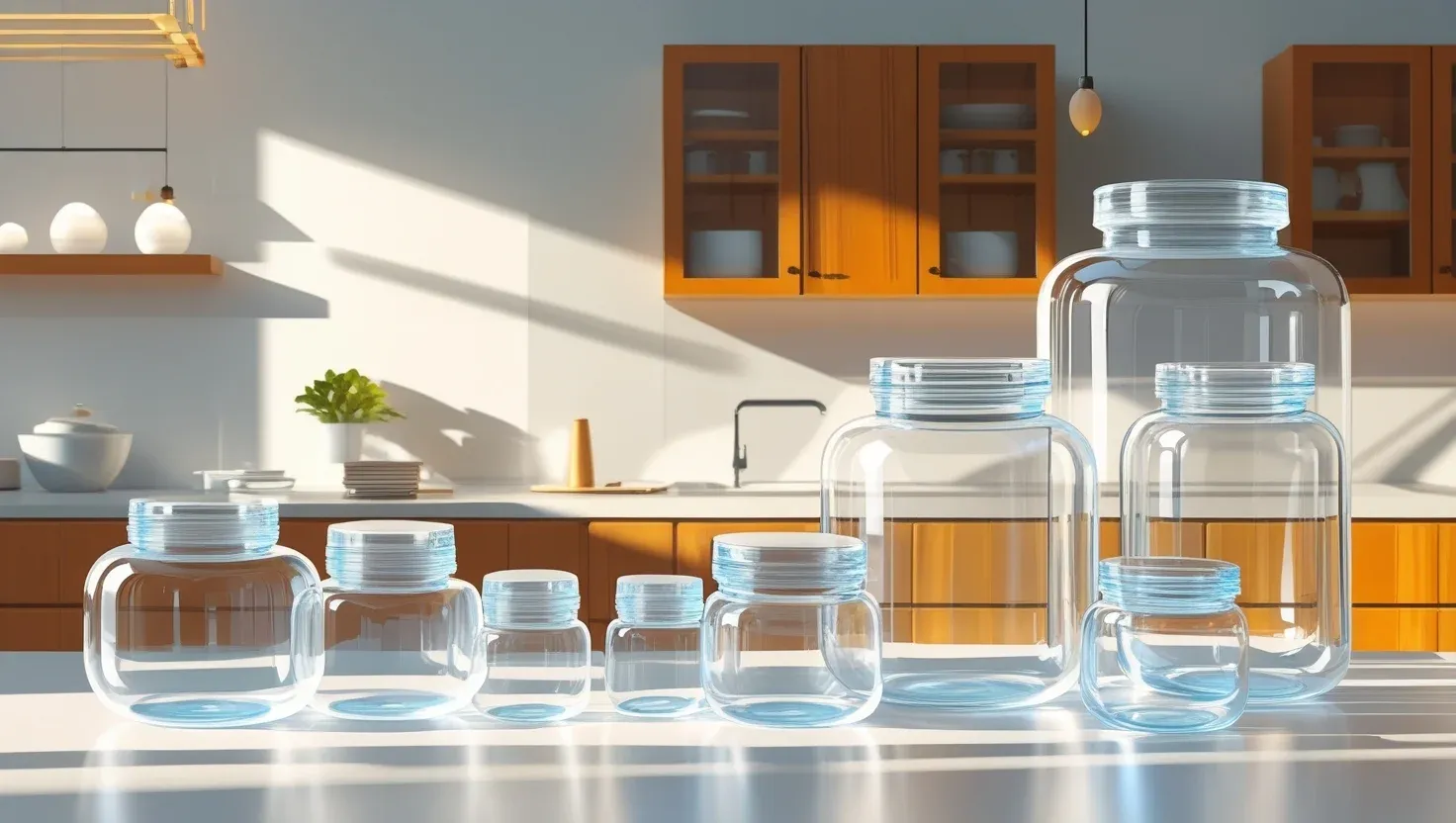
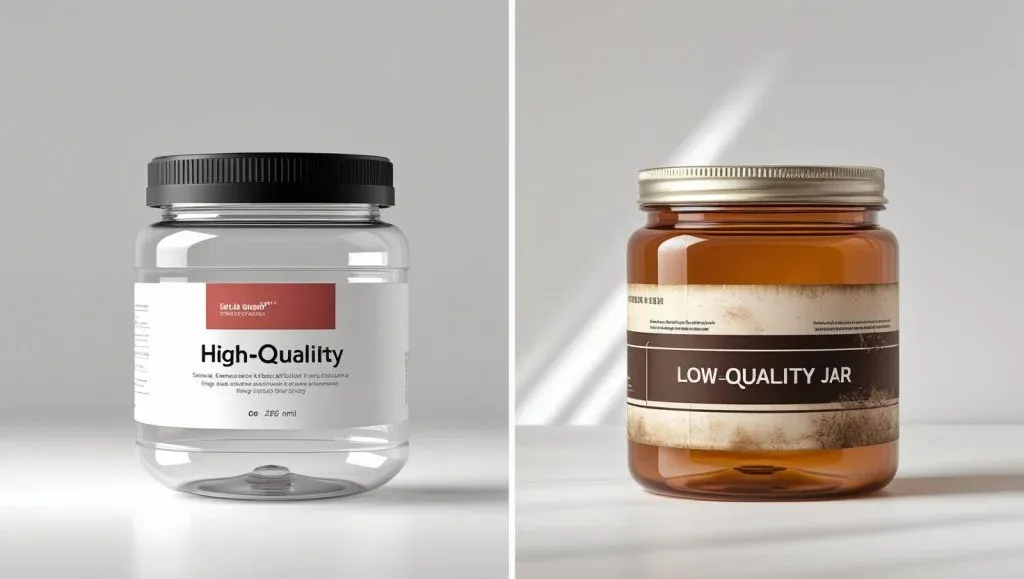
Choosing a plastic jar supplier for retail-pack co-packing comes down to four specifications that are often missed until the first complaint appears: neck finish that does not match the filling line, seal force too low for ocean freight, the wrong resin grade for acidic products, and inconsistent batch-to-batch dimensions that jam labeling machines. This guide discusses the specifications that determine jar performance in the distribution chain — not a household storage-container buying guide.
Market Segmentation: Plastic Jars by Industry
Not every plastic jar serves the same market. Four main segments have different technical requirements.
Food-service and catering distribution need 300–1,500 ml jars with snap-on lids for fast filling-line throughput. Priorities include seal consistency between batches, 1-meter drop tolerance at 80% fill, and stack resistance of at least 6 layers without lid distortion.
Supplement and pharmaceutical brands require certified food-grade PP with optional oxygen barrier for sensitive products. Neck finishes of 38–63 mm with screw-on lids torqued at 1.0–1.8 N·m are standard. Many buyers in this segment require tamper-evident foil seals as a regulatory requirement.
Cosmetics and private-label brands often use PET for premium transparency or 50–300 ml wide-mouth cosmetic jars. The focus is surface finish for IML (in-mold labeling) compatibility and retail aesthetics.
Retail-pack co-packers — roasted coffee producers, premium cookie brands, and artisan jam businesses repacking from bulk — usually need 250–750 ml jars with custom print or labels, BPA-free material, and induction-seal foil options for freshness claims.
Material Selection: PP vs PET vs HDPE
Resin choice is not only about price. It determines product compatibility, filling temperature, and recyclability.
| Material | Resin Code | Temperature Range | Transparency | Advantages | Limitations |
|---|---|---|---|---|---|
| PP (Polypropylene) | #5 | -10°C to 120°C | Semi-transparent | Heat-resistant, widely food-grade, low cost | Less clear than PET |
| PET (Polyethylene Terephthalate) | #1 | -40°C to 60°C | Clear | High transparency, good gas barrier | Not suitable for hot filling |
| HDPE | #2 | -40°C to 60°C | Opaque/milky | Impact-resistant, good chemical barrier | Not transparent |
PP is the default choice for food-service jars because of its wide temperature range — allowing hot filling up to 85°C without deformation and autoclave sterilization up to 121°C. PET is selected when clarity is the top priority (cosmetics, premium beverages), but it must not be filled with hot products. HDPE suits chemical or pharmaceutical products requiring high resistance to solvents.
For acidic products (pH below 4.5 such as pickles, tomato sauce, and citrus juice), use food-grade PP homopolymer for the jar body and PP copolymer only for the lid. Mixing them incorrectly can cause lids to warp during induction sealing and create a 4–7% rejection rate on the filling line.
Form Factor: Volume, Neck Finish, and Lid Systems
Three form-factor variables determine compatibility with your production line.
Standard volumes and dimensions available from Wingoh:
| Volume | OD × Height | Main Use Case | Stock SKU |
|---|---|---|---|
| 100–250 ml | 60–70 × 70–90 mm | Sambal, jam, powdered supplements | Yes |
| 300–500 ml | 75–90 × 90–120 mm | Side dishes, roasted coffee, sauces | Yes |
| 750 ml | 95 × 130 mm | Bulk snacks, dry goods | Yes |
| 1,000–1,300 ml | 105–110 × 155–175 mm | Cookies, cereal, family portions | Yes |
| 1,500–2,000 ml | 120–135 × 175–200 mm | Bulk food, industrial products | Custom MOQ |
Neck finish defines lid compatibility. A 38 mm neck finish is standard for liquids. A 63 mm neck finish suits viscous products and supplements. An 89 mm neck finish is used for wide-mouth bulk snacks. Options outside this range require custom mold development costing IDR 15–35 million (USD 950–2,200) with a 30–45 working day lead time.
Lid systems determine line throughput and product security:
- Snap-on press-fit: Fastest throughput on filling lines, 8–15 N seal force, no tool needed for consumers to open. Suitable for dry goods and refrigerated products.
- Screw-on threaded: Tighter seal for liquids, around 30% slower than snap-on. Standard thread profiles include 38 mm, 48 mm, 63 mm, 70 mm, and 89 mm, with cross-compatibility across many lid suppliers.
- Induction-sealed foil + secondary lid: Highest tamper evidence. Requires induction sealing equipment on the filling line (capex USD 15,000–40,000). Chosen for premium retail or regulated freshness claims.
Quality and Food Safety Standards
Plastic jars in direct food contact must meet three compliance levels.
Domestic (Indonesia): BPOM is mandatory for food packaging sold in Indonesia, including food-grade PP and PET jars. Registration is under MD (domestic production) or ML (import). Check registration status on the official BPOM RI website before accepting shipments from a new supplier.
Exports to Australia/NZ: FSANZ Standard 1.4.3 governs migration limits for food-contact materials. Distributors in this market request batch-level compliance documentation, not only a one-time factory certificate.
Exports to Europe: EFSA Regulation (EC) No 10/2011 applies to food-contact plastics. European buyers commonly request a Declaration of Compliance (DoC) per material plus specific migration data.
BPA-free is the minimum baseline for all food-contact jars. PP (#5) and PET (#1) are inherently BPA-free, but make sure the claim is permanently marked on the jar base, not only stated verbally by the supplier.
For optional oxygen barrier — relevant for oxygen-sensitive products such as roasted coffee or lipid-based supplements — multilayer jars with EVOH layers are available with a 20–35% cost adder compared with standard PP.
Sourcing Economics: MOQ, Price, and Lead Time
B2B plastic jar cost structure operates in four tiers.
Stock SKUs (no customization): MOQ 1 carton (~1,000–3,000 pcs per size). FOB Tanjung Priok pricing for stock PP: 300 ml at USD 0.08–0.14/pc, 750 ml at USD 0.16–0.24/pc, and 1,300 ml at USD 0.28–0.42/pc. Tier discounts start at 50, 200, and 500 cartons per SKU.
Custom print on stock SKUs: 1–4 color screen printing directly on jar surfaces. Cost adder is USD 0.005–0.015/pc depending on color count. Lead time is 15–25 working days from artwork approval.
In-mold labeling (IML): The label is embedded during injection molding, with photo-quality graphics and no peeling risk. Tooling investment is USD 12,000–25,000 per custom mold. Lead time is 30–45 working days.
Custom geometry (new mold): Mold development cost is IDR 15–35 million (USD 950–2,200), with a first-run MOQ of 200,000 units. Suitable for brands that need shape differentiation on the retail shelf.
For international POs, the correct HS code for plastic jars is 3923.30 (plastic containers for goods transport/packing). Misclassifying them as 3924.10 (plastic tableware/kitchenware) causes customs delays in many first-time imports.
Wingoh Production Capabilities
Wingoh Albindo has produced food-grade PP plastic jars in Tangerang since 1992, with FSSC 22000 certification supporting compliance documentation for Australia, Europe, and Indonesia’s BPOM market. Production uses multi-cavity injection molding with dimensional control each shift.
Stock plastic jar lines are available from 100 ml to 1,500 ml, with snap-on, screw-on, and induction-seal foil lid options. Customization options include color screen printing, embossed logos, and custom geometry with 30–45 working day mold development. See the full catalog on the plastic jar product page.
For specification audits or first-tier pricing negotiation, Wingoh’s procurement team can provide 1-carton samples per SKU, dimensional specification sheets, and vacuum decay test reports for available jar geometries. Contact the sales team to confirm current stock and the next production-run schedule.